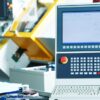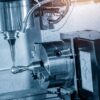
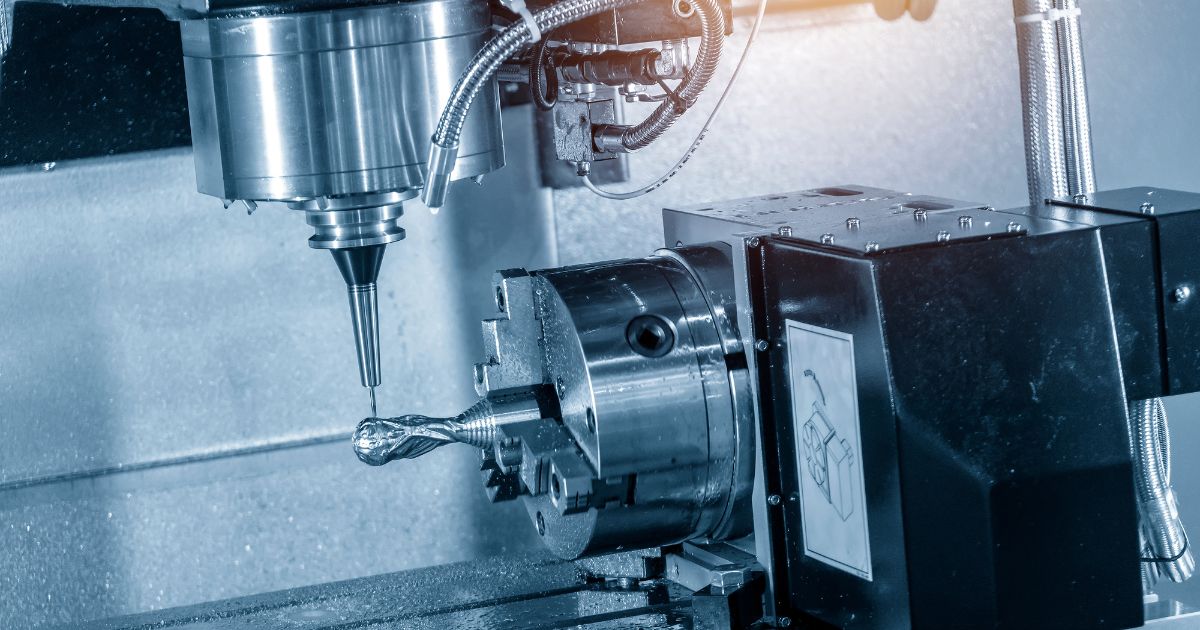
A turbine blade, a titanium dental implant, an injection mold with deep undercuts: they are pieces that a three-axis milling machine does not produce in a single setup. Two more movements are needed, two rotations that tilt the piece or the spindle head and allow the tool to reach any face of the geometry. It is the logic of the work center 5 axis, the machine that over the last fifteen years has redesigned the way mechanical workshops work, mold departments and aerospace subcontractors.
What is a work center a 5 axis
And CNC machining center it is a numerically controlled machine tool that performs milling, drilling, automatic boring and tapping, changing tool from a magazine without manual intervention. The number of axes indicates how many simultaneously controlled directions of movement the machine makes available.
A CNC machining center 5 assi controlla tre assi lineari — X, Y e Z, le tre direzioni dello spazio cartesiano — più due assi rotativi, identified with the letters A, B or C depending on the linear axis around which they rotate. The result is that the tool can present itself to the workpiece in any orientation within the machine's work envelope.
The practical difference is measured in placings. A prismatic piece with five-sided machining requires, on a three-axis machine, at least four or five distinct fixtures, each with its reset and its error. On work centers 5 axis the same piece comes out complete from a single clamping.
How it works: the three linear axes and the two rotary axes
Linear axes move the tool or table along ball screw-driven guides or, in the most dynamic machines, linear motor. Rotary axes add tilt and rotation.
The A axis rotates around X, the B axis around Y, the C axis around Z. A work center 5 aces uses two of the three, typically A and C or B and C. The chosen combination determines the kinematics of the machine and the type of parts it processes best.
The numerical control coordinates the five movements in real time. When the tool follows a complex surface, the CNC continuously recalculates the position of the tip and compensates for the movements induced by the rotations: the function that takes care of this is called RTCP (Rotational Tool Center Point) or TCPM and is what makes five-axis interpolation viable. Without this compensation, each rotation of the head would move the tip of the tool with respect to the programmed profile and the program would have to be reconstructed by hand.
5 continuous axes e 3+2 position yourself: the difference that matters
Not all five-axis machining works the same, and the distinction is the first point to clarify before evaluating an investment.
In the mode 3+2, also called indexed positioning or 5 positioned axes, the rotary axes bring the piece to a certain angle and then stop. The actual milling takes place with only the three linear axes. It's a robust technique, simple to program, which uses short and rigid tools and drastically reduces setup times compared to a three-axis machine.
In the mode with five continuous axes, or simultaneous, all five axes move simultaneously during removal. It is used for double curved surfaces, impellers, impeller, pale, organic geometries of the medical sector. This is where the machine expresses its best, and it is also here that the programming complexity and cost of CAM increase.
Most production departments use the 3+2 for eighty percent of the cycles and simultaneous for the remaining twenty. Who evaluates a work center 5 aces should estimate this proportion on their mix of pieces: The machine to choose and the level of software needed changes significantly.
Work centers 3, 4 e 5 axes compared
Il three-axis center moves the tool along X, Y e Z. Work one face at a time, requires dedicated equipment and manual repositioning. It remains the most economical solution for flat pieces, 2.5D plates and processes.
Il four-axis center adds a rotary table, usually the A axis. It allows the piece to be machined on multiple sides without removing it from the clamping and is very effective on cylindrical parts or repeated radial machining.
Il five-axis center adds the second rotation and with it complete freedom of orientation. The advantage is not just geometric: shorter tools, fewer changes, greater rigidity, possibility of working in peripheral milling instead of tip milling, where the cutting edge works in the worst conditions.
The jump in cost between three and five aces is significant, but the correct comparison is not made on the price of the machine. It is done on the hourly cost of the finished piece, including equipment, Tempi is setup, waste from repositioning and hours of qualified labor.
Machine configurations: table-table, head-head, head-table
Kinematics distinguishes three families, and each has a specific field of use.
Table-table (table-table): both rotary axes are on the table, typically a rotary table that tilts and rotates the piece. It is the most widespread configuration in work centers 5 small to medium sized vertical axes. It offers great rigidity and precision, but it limits the weight and size of the workpiece.
Head-head (head-head): the two rotations are in the spindle head, while the piece remains stationary on the table. È la scelta obbligata per particolari grandi e pesanti — carpenterie aeronautiche, resin models, stampi di grandi dimensioni — e caratterizza i centri a portale e le macchine gantry.
Head-table (mixed configuration): a rotation in the head, one on the table. It is a compromise that balances load capacity and dynamics, frequent in mid-range machines.
The advantages of processing a 5 axis
Reduction of placings. The piece is blocked only once. Every fixture eliminated is a repositioning error eliminated, and on tight tolerances it is the variable that weighs most.
Dimensional and geometric precision. The relationships between the faces machined in the same cycle do not depend on the skill of the operator but on the precision of the axes. Positional tolerances and concentricity improve measurably.
Superior surface quality. Tilting the tool, the cutter works with the flank of the cutting edge rather than the center, where the cutting speed is zero. The finish improves and in many cases manual polishing becomes superfluous.
Shorter tools and longer life. Orienting the workpiece instead of lengthening the tool reduces overhang, contains vibrations and extends the life of the cutting edge. When machining titanium and refractory alloys, the effect on tool costs is immediate.
Lower cycle times for the same piece. Less setup means less machine downtime. On medium and small lots, where the setup time affects more than the cutting time, the profit easily reaches forty percent.
A single operator for multiple machines. The autonomy of the cycle paves the way for unattended work and integration with pallet systems and robotic cells.
Workable materials with a center a 5 axis
Metal machines process structural and tool steels, stainless steels, cast iron, aluminum and its alloys, copper and brass alloys, titanium, Inconel and nickel-based superalloys. Each of these materials imposes cutting parameters, different cooling and tool geometries, and the rigidity of the machine is the constraint that decides how far you can go.
There are families of work centers 5 boards designed for non-metallic materials: solid wood and panels for the furniture and structural sectors, composites and carbon fiber for aeronautics and boating, resins, foams and patterns for foundries, technical plastic materials, stone and mineral composite materials. Cambiano potenza e regime del mandrino — dai 12.000 revolutions of AI steel machines 24.000 e oltre degli elettromandrini per legno e compositi — cambiano il sistema di aspirazione e i sistemi di bloccaggio, often to depression.
Applications and sectors: aerospace, physician, pictures, automotive
Aerospace. Centines, ordinate, spars, turbine blades, structural components machined from solid with removals of up to ninety percent of the initial volume. Five-axis machining is an established standard here.
Medical and dental. Hip and knee prostheses, plates and screws for osteosynthesis, surgical instruments, implants and structures in titanium and chrome-cobalt. Organic geometries, tight tolerances, total traceability.
Molds and matrices. Injection molds, for die casting, for blowing, punches and blanking dies. Accessing deep cavities with short tools reduces vibration and improves finish, reducing hand polishing time.
Automotive e motorsport. Cylinder test, collectors, suspension components, functional prototypes, racing pieces in very small series.
Energy. Impellers, impeller, valve bodies, components for gas and steam turbines.
Wood and furniture. Laminated wood structures for construction, windows and doors, curved elements, naval fittings.
CAM, post-processor and numerical control: the role of software
A five-axis machine without a proper software chain is as expensive as a three-axis machine. The CAM must manage multi-axis milling strategies, control of the tool-piece contact angle e, above all, the calculation of collisions over the entire envelope of the machine, head and equipment included.
Il post-processor translates toolpaths into the specific numerical control language. It's not a minor detail: a generic post-processor on five-axis kinematics produces non-optimized movements, unnecessary rotations and real risk of collision. It must be developed and tested on the single machine-control combination.
The simulation closes the circle. Before sending a simultaneous five-axis program to the machine, the cycle must be verified in a virtual environment with the real kinematic model. It is the practice that separates a department that exploits technology from one that is subjected to it.
On the control front, the functions that matter are RTCP/TCPM, three-dimensional compensation of the tool radius, the extended look-ahead for managing the dynamics on curved trajectories and automatic measurement cycles with a probe.
Limits, operating costs and skills required
The initial investment is higher. A work center 5 new axes involves a financial commitment that, the parity of runs, it can be double or triple compared to an equivalent three-axis, and multi-axis CAM must be added to the machine, post-processor, dedicated equipment, tool setting and training.
Skills are the most underestimated constraint. Five-axis programming requires mastery of CAM, understanding of specific kinematics and ability to read the simulation. A programmer trained on three axes takes months, not days.
Maintenance is more complex: the rotary axes, rotary tilting tables and bi-rotating heads require periodic clearance and precision checks, and the geometric check with ballbar or kinematic check must be planned regularly.
Finally, there are physical limits. The angular travel is not infinite, extreme undercuts remain unattainable and each configuration imposes a precise working window. The actual useful volume of a five-axis machine is always lower than the declared strokes, because rotations consume space.
How to choose a machining center a 5 axis: the parameters to be evaluated
The size and weight of the pieces determine the configuration. Compact and heavy pieces orient towards the table-top; large, light pieces towards the gantry.
Linear axis travel and angular excursions must be compared with the real volume of the details, not with their nominal size.
The rotary tilting table it is evaluated on diameter, maximum flow rate, locking torque and presence of direct drive (torque motor), which offers superior dynamics and precision compared to worm gear transmission.
The spindle you choose on power, couple, maximum speed and type of attack. Steel and titanium ask for torque at low rpm; aluminum, wood and composites ask for turns.
The tool warehouse must cover the number of tools of the more complex cycles without manual spare parts, necessary condition for unsupervised work.
Numerical control it must be evaluated on the multi-axis functions that are actually active, not on the declared model: RTCP, measurement cycles and kinematics management are options, not discounted features.
The declared precision it is read according to ISO standards 230-2 and must be compared with the tolerances required by the pieces, considering that thermal stability affects as much as nominal precision.
The accompanying services — assistenza, spare parts, training, tempi di intervento — pesano sul costo orario reale quanto le caratteristiche tecniche.
On the supply side, the choice is divided into two paths. I work centers 5 new axles guarantee tailor-made configuration, full guarantee and latest generation controls, with delivery times that exceed twelve months in periods of high demand. The market of used machining centers instead it offers immediate availability and lower fixed capital, in the face of a more careful technical check on working hours, status of the rotary axes and documented revisions.